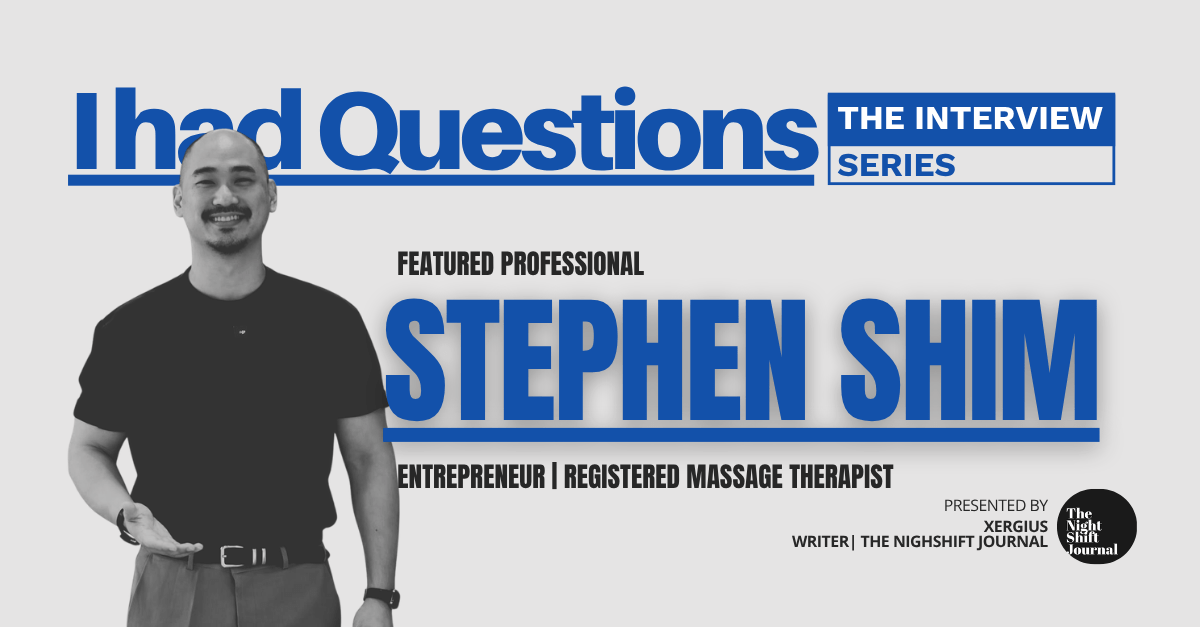
Stephen Shim| Registered Massage Therapist | Entrepreneur
Stephen didn’t grow up dreaming of becoming an RMT. Matter of fact, he is like a lot of us, confused, always looking for something more. Juggling three jobs at once, he drifted from role to role, chasing the feeling of a fulfilling career, always grinding and carrying injuries. Broken shoulders, back and neck issues stacked faster than he could recover.
But life always finds a way to test even the strongest among us.
In Jan 1st, 2020, Stephen got hit harder than any physical injury he had taken. The passing of his Father brought grief in his already hard life, but with this, a new story started to unfold. In one of their final conversations, his father told him: “Live your life and get back to studying.” Stephen took this to heart and from then on, he embarks on a journey that redirected his path.
Massage therapy was never a plan in the beginning. It we’re merely sessions Stephen was attending to heal his injuries. But eventually he realized he could give others what he had spent years searching for, relief, clarity, and a way back into their own bodies.
This isn’t a story about a career change. It’s the story of a man who spent half his life feeling lost, only to discover that the thing he was meant to do was the thing he needed most: to ease pain and help people feel whole again.
In this conversation, me and Stephen reflected on his journey, slowly he opens up and provided us with a heartfelt story that not only talks about his career but the steps he took that got him here.
Let’s take a look.
What inspired and drew you to become a Massage Therapist?
“I actually started as a patient. I worked in the casino industry for years, juggling two or three jobs, and I got injured a lot, shoulders, back, everything. At first, I thought a massage was just something that made you feel good. But when I started getting treated, I realized they weren’t just rubbing my muscles; they understood the cause, the root of the pain, why it was happening, and how to fix it. That fascinated me. I thought only doctors, Physios or Chiros did that.”
He adds that one of the RMT’s he saw encouraged him to try the field. Then a week later, he registered for school, but the real push came from his father’s final words: “Live your life and get back to studying.” That became the catalyst that changed everything.
How does your background in Massage Therapy help you manage your own pain?
“Honestly, I feel pain more now because I understand it better. Before, I thought shoulder pain or back pain was just “normal.” Now I know why it’s happening. My poor posture, habits, sleep, and my old graveyard shifts all contributed to the pain I was having. But because I now understand my patterns, I know how to better treat myself. I use massage balls, foam rollers, and regularly visit other RMTs and physios as well.”
He laughed as he shared: “I don’t foam roll every day like I tell my patients to, I should, but I try to do it two or three times a week.”
Is there a consultation first before you start working on your clients?
“Always. RMT work isn’t like a regular relaxation massage. RMT care goes beyond relaxation alone. While it can be deeply relaxing, it also focuses on assessment, identifying underlying causes of discomfort, and supporting recovery and function.“
“We need to understand the condition, how it happened, why it hurts, what movements trigger it, what their daily life looks like. I ask open-ended questions, watch how they stand, how they walk, and even ask how they sleep. People don’t always realize what they’re doing with their bodies until you point it out.”
Do you follow a fixed routine when working on a client?
“I don’t use a fixed routine because everyone’s body reacts differently. Some people respond better to manual therapy, others to active or passive stretching. Some need focused pressure on a specific muscle, while others need a completely different approach. I adjust based on my findings and how their tissue responds. My goal is to treat the actual source of the problem, not just the spot where the pain shows up.”
When someone comes in with pain, what’s the first thing you pay attention to before any hands‑on work begins?
“Posture and movement. How they walk in, how they stand, how they point to the pain. Sometimes they say it hurts on one side, but their body language shows something different. I look for compensation patterns, because pain in one spot doesn’t always mean the problem is there.”
He added that sometimes patients don’t know the real source of their pain, usually a lot of complaints are coming from localized pain they are experiencing at the moment, but sometimes, it might also be an underlying medical issue that we don’t know of just yet.
How do you adjust techniques for different body types?
“People think that bigger people will always need more pressure, but that’s not true. Some respond really well to light pressure. And there are also situations where smaller individuals need much deeper work because that’s what the situation calls for. I work toward what we often describe as the first point of tissue resistance, where I begin to feel the body pushing back. From there, I gradually progress based on the client’s comfort and how the tissue responds.”
What tension pattern do you see most often?
“This is very sad and true at the same time. Most of us have desk jobs now and do work that does not require a lot of movement, and that contributes to a lot of problems I’ve seen with my clients. The most common are upper back tightness, neck tension, lower back pain, and glute issues.”
Stephen explained that these problems can also come from everyday habits. The way someone sleeps, stands, walks, or sits. He explains that muscles can become either shortened (overactive) or lengthened and weakened over time. When a muscle stays in the same position for prolonged periods, whether shortened or lengthened, it can become irritated, dysfunctional, and contribute to pain.
What’s one thing you do differently from other massage therapists?
“I really care. I know a lot of RMTs’ care, so I’m not saying I’m the only one, but I genuinely want my patients to get better. I try my best to create a safe and friendly environment while staying focused on helping them improve and get better. I also study every day, even at home, looking up new trends and techniques to improve myself as a healthcare provider.”
What’s the hardest part of your job?
“Seeing people in pain and knowing it might take time to fix it. Some people want instant results, but the body doesn’t always work that way.”
What’s the best part of your job?
“When someone gets off the table and says, ‘I feel better.’ Or when they come back and tell me their pain is improving. I genuinely think I am contributing to someone else’s well-being. That makes me happy every time.”
Thoughts & Opinions
Opinion on cold plunges?
“It’s awesome. I love it. I think cold plunges are great. I use them all the time, and I genuinely believe in their benefits. Even though a lot of research points to mental health as the main area where people see improvements, my own experience has been really positive. Cold exposure helps me relax, sleep better, and feel more energized. It supports muscle recovery and overall cardiovascular health.”
Thoughts on warmups?
“Warmups are really important, and I always remind my clients about that. I can’t stress it enough. I encourage people to warm up before they work out or go for a run, because it makes a big difference. Think of it like putting WD‑40 on your joints and prepping your muscles, you want your body to loosen up and get ready before doing anything intense.”
Opinion on stretching?
“Stretching is just as important. I usually explain it in two main types: dynamic and static.
Dynamic stretching is best used before activity. It involves controlled movement through a range of motion to prepare the muscles and joints.
Static stretching is typically done after activity or during recovery. It involves holding a position to help reduce muscle tension and improve flexibility over time.
For example, if a muscle’s primary action is to bend a joint, stretching it would involve moving that joint
in the opposite direction. The goal is to gently lengthen the muscle and improve its tolerance to stretch, not force it.”
Life, Mindset, and Growth
When you feel stuck or overwhelmed, what’s your first move?
“When I get really stressed, the first thing I do is sleep. My body just shuts down and it’s like my brain forces me to rest when everything becomes too much. Sometimes I’ll just sit in my car and chill, I’ll sing or just sit there quietly. It’s not that I’m trying to run away from stress; I just want to step away for a moment, rest, reset and usually I deal with things right after.”
At this point in the conversation, I could sense Stephen becoming a little more guarded with his answers. The questions ahead touched on his experiences as a person, not just as a healthcare practitioner, and he seemed to shift into a more careful, reflective space as he responded.
What’s a failure or rejection you’re grateful for?
“Failing the RMT board exam the first time.”
It took him a while to share this.
He explained that while he studied seriously, he later realized he could have used his time more effectively, especially when it came to hands-on preparation for the practical components of the exam.
That experience humbled him and pushed him to become more intentional and disciplined in how he prepared.
After six months of focused effort, refining both his knowledge and practical skills, he successfully passed the board exam.
Looking back, he recognizes that although he always puts effort into studying, this experience taught
him how to study smarter, not just harder.
“If I had passed the RMT boards the first time, I probably would have stayed arrogant. That failure made me better, as a person, a student, and now as an RMT.”
What’s the best advice someone has ever given you?
Stephen, a self‑confessed momma’s boy; shared the words his mother told him, words he still carries with him today:
“Just because you’re bad at something now doesn’t mean you’ll stay that way. Just because you’re struggling now doesn’t mean that’s your future. The current you isn’t the future you. Your current condition doesn’t determine who you’re going to be. Just work hard.”
No one ever really knows where life will take them. But as the saying goes, mother knows best.
Beautiful.
I pressed on,
What’s the worst advice someone has ever given you?
“That having pain in your body is normal. It shouldn’t be.”
Simple, but true.
Stephen then called out my poor posture, and like a master, he pointed out what he could see from where I sat, how tensed my shoulders were, and how my neck shows that I was a side sleeper.
“It must hurt,” Stephen asked.
“You would know”, I quickly jested.
“I bet you have headaches”
“I sure, f**king do.”
It felt like I was the one being interviewed, because he knew exactly what he was talking about.
Which small habit has made the biggest difference in your life or career?
“It’s not something I do every single day, but whenever an opportunity comes up that I would’ve said “no” to before, I tell myself, “F*** it, let’s do it.” That mindset has helped me grow a lot. I would’ve turned down anything like this before because I was too shy.”
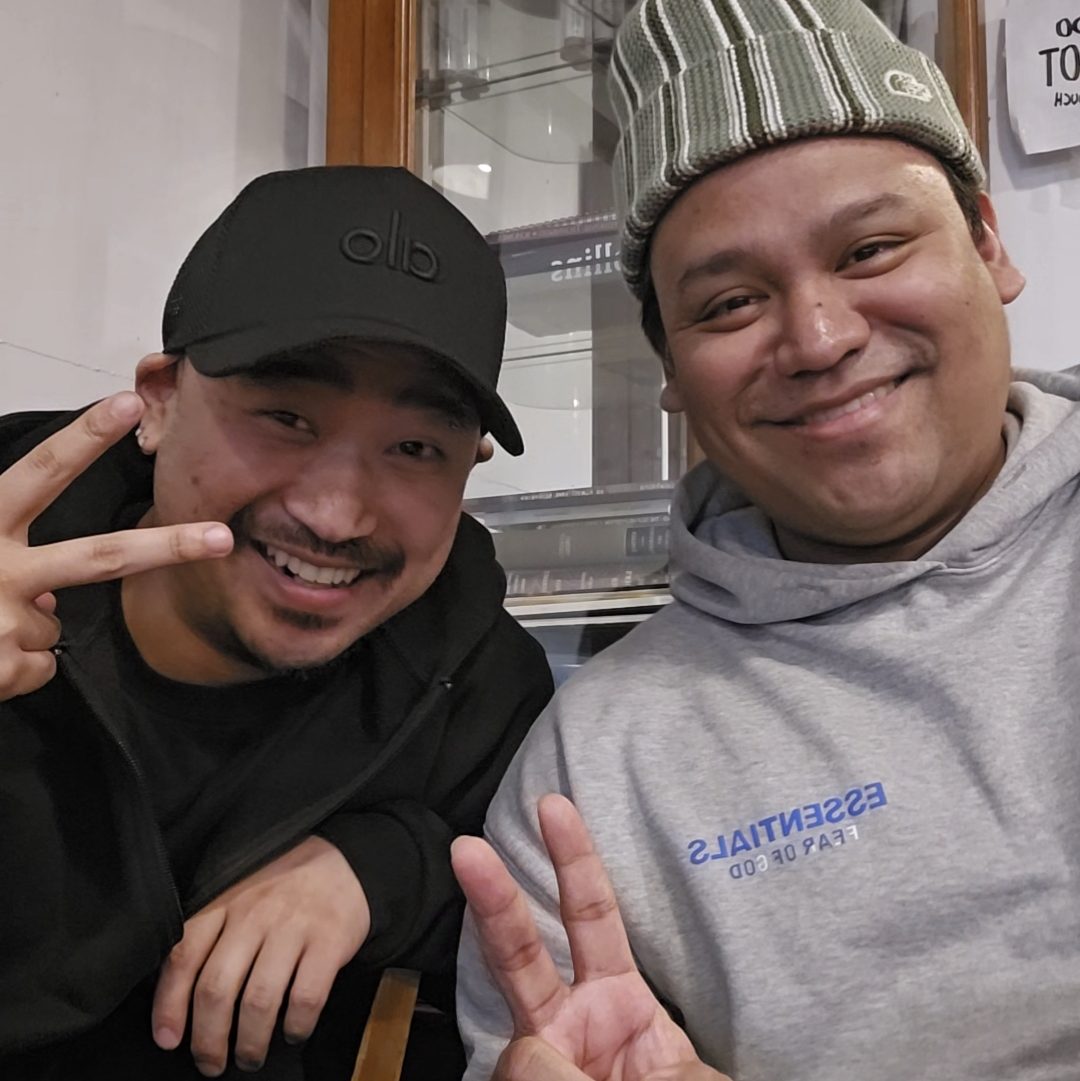
We were 54 minutes deep into our conversation, my latte is gone, Stephen’s Iced Chai is nearing the bottom.
But I could push it a bit further.
I had more questions to ask.
And I could see him opening up a little bit,
Next question,
What piece of advice would you give to your younger self?
Stephen paused for about 30 seconds, he thought really hard and looked at me, as he smiled.
“There’s so many things I want to tell my younger self, but I don’t know where to start”
I looked at my phone and my recorder
We hit the one-hour mark of our conversation.
Seeing him struggle…
“Let’s take a break”
Stephen stood quickly, took a sip of what remained of his watered-down Iced Chai, and made his way outside of the coffee shop.
About 5-7 mins had passed; he sat back down, and I rephrased the question.
“If you were to see little Stephen, what would you tell him?”
He must have thought about it outside.
Because he quickly replied.
“I’d tell my younger self: Don’t try to be perfect. It’s okay to start small. Put more effort into school and into life. You’re good enough, but you can do better. And I’d remind him to smile more, too.”
Your favorite quote?
“I don’t really have a favorite quote, but the closest thing would still be what mom told me: The current you isn’t the future you. Your current condition doesn’t determine who you’re going to be. That’s the line that’s guided me the most.”
As we got closer to the end of our conversation, Stephen shared a lot of things about his childhood and journey growing up, the struggles he endured and the great things he experienced, some things I would keep between the two of us, and some lead me to ask these final two questions..
Are you happy?
“Yeah, I’m happy. I don’t see happiness as some huge, dramatic thing anymore. For me, it’s in the small moments. If I’m laughing with someone, meeting someone new, or something just makes me smile, that’s happiness. It changes minute to minute. If I’m laughing with you right now, I’m happy. If I see something that makes me smile, that counts too. And I’m working on being even happier, one small moment at a time. Right now, I could say I’m happy talking to you.”
Do you think Little Stephen would be proud of who you are right now?
“Firstly, yes he would be proud.”
He pauses for a moment, and repeats it, “Yes, I think he would be”
Stephen continues…
“But honestly, I don’t know. I’m happy right now, and I know I’m doing way better than before. I’m happier than I’ve ever been. But I don’t know if my younger self would be proud, because maybe he’d think I could do more, and he wasn’t smart enough back then to understand who I am now.”
He shifted his gaze towards the outside of the cafe for a moment, and back on to me, as he kept on.
“I think my root has always been helping people. Even when I was young, I was happiest when I was helping someone. I didn’t realize it back then, or maybe I didn’t want to acknowledge it, but that’s really who I am.”
And because of that, I have to love the younger Stephen too. Even if he didn’t understand anything yet, even if he was lost, that part of him was still there. Now that I’m older and I understand myself better, I can see that clearly.”
This time he says it more with confidence,
“Yes, little Stephen would be proud of me.”
He then reached for his lapel microphone,
started unclipping it from his jacket..
“That’s it right, we’re done?’”
as he was handing it to me,
I reached for it and had him plop it onto my open palms.
I took my mic off…
“Yeah man, that’s it, Thank you so much.”
We talked a little longer after that and agreed to meet again soon. I’m looking forward to reconnecting, and I’m genuinely grateful to have crossed paths with Stephen Shim and to now call him an acquaintance.
Stephen’s story is not about a dramatic career change or a list of credentials. It is not about his license, a roster of clients, or the idea of owning a clinic. It is about the people who shaped him, the ones whose words stayed with him, and whose influence helped him return to who he always was.
His story is about reconnecting with his roots, from his father’s final words to his mother’s advice, and to the younger version of himself who simply wanted to help others.
What drives him now comes from within. He is now more inspired and motivated to heal himself and others.
The pain he carried for years did not harden him. It taught him how to understand the pain of others. It gave him empathy, patience, and a way of seeing people that goes beyond just technique or training.
He never tried to run from his past. Instead, he used it to become who he is today: someone resilient, caring, compassionate, and determined to break a chain of struggle by choosing to pursue his real calling.
And that might be the real lesson in his journey. Healing is not just a profession. It is a continuous effort, a choice we make day after day to grow into someone better than we were before.
Stephen is only beginning, but he has already become the person he needed most when he was still suffering and struggling, someone who can ease pain, offer relief, and understand what people carry.
This is the path he walks now, and he’s not alone. His experiences, both as a patient and as someone who has struggled and grown, allow him to understand others in a way he could not before.
 XERGIUS.COM