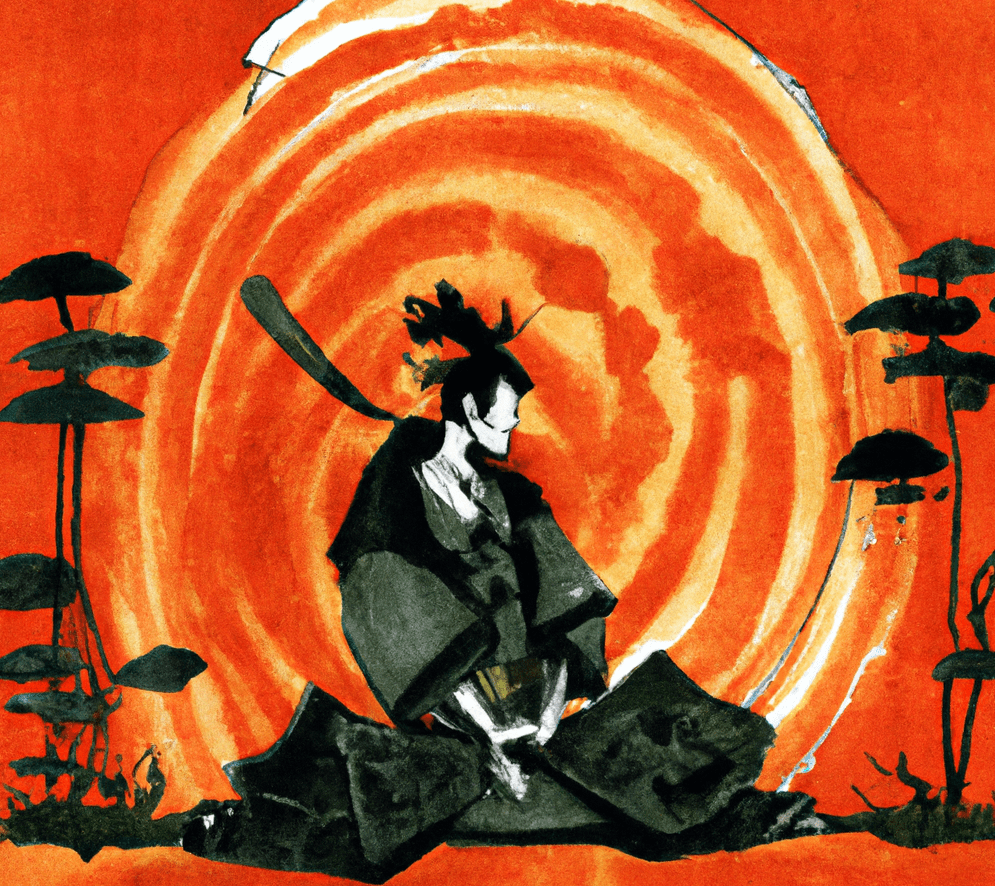
In 2021 I encountered a book called “The Book of Five Rings” it was a short read, the version I have has about 150 pages of reading material. It was hard. I thought I was reading a book about martial arts that is now obsolete, I could not relate it to my life or anything that I was doing at that time, but as I went deeper, it started to make a little sense.
I never really knew who the author was, nor had I read any of his work but as I read through the book I started to encounter more and more about Miyamoto Musashi, everywhere I turn to, something about this legend somehow gets his way into my silly mind.
In Anime, they describe Musashi as a legendary samurai who has never been defeated in battle, while listening to a Rogan podcast, Joe shared about his favorite quote, “when you see things broadly, you can see it in all things” and then after that showed his tattoo of Miyamoto Musashi.
The Manga vagabond, one of the most beautiful works of art I have seen is unknowingly a story about the legend of Miyamoto Musashi and then later a podcast with Tim Ferris and Jocko Willink surprisingly talked about The Japanese novel Musashi, this all happened within a span of 2-3 weeks after I started The Book of Five Rings
Baader – Meinhof phenomenon
Also known as the frequency illusion, this phenomenon is a cognitive bias where a person who just learned or noticed something new starts to see it everywhere, this phenomenon occurs when the brain becomes more attuned to information that has been acquired, leading to the belief that it has a higher frequency or prevalence than it does.
Having to experience this most definitely piqued my interest, that’s when I decided to dive deeper into Musashi.
There is no definitive historical account of Musashi Miyamoto’s life, the least I could do is share to you a very brief knowledge I have about the Man.
Miyamoto Musashi, also known as Kensei or the Sword Divinity, was a legendary samurai who dedicated his life to perfecting swordsmanship.
He received early training from his father. Musashi engaged in his first duel at 13 and defeated a skilled warrior at 16.
His fame spread in 1604 at 21 years old when he defeated three members of the Yoshioka Family swordsmanship school in Kyoto.
The Pinnacle of his career came in a historic duel in 1612, when he defeated the founder of Ganryu School, Sasaki Kojiro who was a renowned samurai. This victory led Musashi to question the reasons behind all his success, leading him to embark on a lifelong quest for self-discovery.
During this time, he continued to perfect his two-sword technique which was very unique back then, after adopting two children, Musashi spent his last years as a hermit, teaching his disciples while studying Buddhism, meditation and writing “the 35 sections of Kenjutsu”
He died in 1645, leaving behind a legacy of martial arts, a school of swordsmanship, artistic and poetic achievements which were all rounded up in his life’s work called The Book of Five Rings.
It was said that during his funeral, a thunderous lightning bolt stroke the whole sky, as Gods and deities were welcoming the powerful warrior into their stead.
The Book of Five Rings
The principles of The Book of Five Rings extend beyond the context of battle and martial arts, despite Musashi being a battle strategist and a warrior, and his work associated with those pursuits, his book can be applied not only in warfare but also in business, career and decision-making. Musashi’s insights are applicable in various aspects of life, making it a timeless and widely studied work.
While the modern world may not necessarily engage in traditional martial arts or warfare, some highly effective individuals exhibit qualities related to each volume within the Book of Five rings in their respective fields.
This is my interpretation of Musashi’s work, take and read everything with a grain of salt, I am no expert, I am no philosopher, but I would like to share what I got from this.
The Earth Book: Stability, Firmness, and Adaptability
This book discusses the basics of martial arts and the foundation of Musashi’s strategy. It emphasizes the importance of understanding the fundamentals, knowing the basics of your pursuit as it is the foundation that one will stand on to create future success for oneself.
Solid stance emphasizes the importance of being grounded and stable in both physical and mental aspect while also touching into the firmness of one’s decision making.
Understanding the terrain of battle extends the metaphor of earth, Musashi discussed the importance of being aware of the environment and using it to one’s advantage, the Earth book lays a solid groundwork for an adaptable approach to strategy.
Warren Buffett (1930–2021): the legendary investor, is known for his disciplined and adaptable approach to investing. He not only has a basic knowledge about different markets but also a complex understanding of the businesses he owns. He emphasized the importance of staying informed, being self-aware about one’s investment decisions, and adapting strategies as market conditions change. His mindset aligns with the principles of foundational knowledge, adaptability and awareness discussed in “The Earth Book.”
The Water Book: Flexibility, and the ability to flow around obstacles
Musashi discusses the concept of Fluidity, being flexible in strategy, adapting to circumstances, and flowing like water to overcome challenges. Water represents the ability to change tactics based on the situation.
The importance of not sticking to a rigid set of techniques or formlessness, which can also be associated with the ever-changing climate of society, as we progress in life, we assume different roles which call for a different approach. He advocates for a mindset that can change and adapt based on the shifting dynamics of a battle.
“Be Water my friend” – Bruce Lee, 1971.
Bruce Lee (1940-1973): a martial artist, actor, and philosopher known for his innovative approach to martial arts and the creation of Jeet Kune Do, a martial art philosophy that encourages simplicity, directness, and adaptability.
Adaptability: Bruce Lee emphasized the importance of adapting to situations at hand. He believed that one should be flexible and able to adjust to different circumstances just like water.
No Fixed Form: Like Musashi’s advice against fixating on a particular style, Bruce Lee rejected rigid martial arts styles. He encouraged formlessness and to adopt techniques and strategies that were most effective for them. He was fond of attacks that were dangerous and deadly because he believed that a fight should only last a few seconds.
Flowing with Circumstances: Water adapts to its surroundings, and similarly, Bruce Lee encouraged individuals to flow with the circumstances they face. This meant not being constrained by set patterns but being able to respond spontaneously to challenges.
The Fire Book: Passion, Intensity and Aggressiveness
The Fire Book is metaphorically associated with the intensity of fire. Musashi uses fire as a symbol to convey the importance of passion, energy, and aggression in one’s chosen endeavor. This section revolves around the proper use of aggressive tactics, the psychological aspects of combat, and the mindset required to overcome opponents or life.
Musashi also emphasized the need for decisive and bold actions on the battlefield, this includes taking initiative, controlling the tempo of a confrontation, imposing your will and the importance of instilling fear and uncertainty in your opponent’s mind.
Mamba Mentality
The legendary Kobe Bryant was not only known for his skills in basketball but also remembered as the ultimate competitor. His peers remember him as an aggressive offensive force, fiery and passionate towards the game and possesses an unparalleled work ethic.
The term Mamba Mentality took shape over the course of a long tenure for Kobe, however this term gained prominence in the later years of Kobe’s playing career where he adopted this persona to channel fierce and relentless mindset both on and off the court and then later extended into his post-retirement lifestyle.
Mamba mentality is a mindset and approach to basketball and life that is widely practiced by some current generation stars like Devin Booker and Jason Tatum. The key principles and elements of the Mamba mentality mirror “The Fire Book”
Kobe played the game with fearless aggression, he was not afraid to take the most challenging shots, take on high pressure moments and guard the best players of the opposing team, in some cases he did all of these while playing injured.
Kobe was the ultimate competitor who always strived to win no matter what the cost, it may be an injury or be blamed for a missed jump shot in crucial moments, he encourages refusal to quit and refusal to settle for mediocrity or shame.
Musashi’s emphasis on boldness resonates Kobe’s willingness to take charge in the most decisive moments, known to be a clutch player, stepping up when the stakes are at its peak, his ability to control the game with his skill instilled fear in the opponents’ minds couple with his intensity and determination.
The Wind Book: Elusiveness, Observation, Distraction
In the Wind Book, Musashi metaphorically associates wind with adaptability and strategic positioning. It symbolizes Elusiveness, Subtlety, and the exploitation of an opponent’s weaknesses.
Musashi encourages the strategic use of movement, positioning, and timing in martial encounters. The wind’s changing nature mirrors the need for individuals to be elusive and unpredictable. Understanding the battle’s ebb and flow, adapting tactics accordingly, and exploiting vulnerabilities reflect the Wind book’s themes.
The Wind Book imparts essential lessons on strategic thinking, adaptability, and exploiting opportunities.
Although Genghis Khan was not a Martial artist and his era predated Musashi, Genghis Khan’s military strategies reflect some of the core principles found in the Wind Book, particularly in terms of adaptability, exploiting weaknesses, and understanding the fluid nature of conflict.
Khan invested heavily in intelligence gathering, his scouts and spies effectively provided crucial information about the strengths and weaknesses of his enemies, this allowed Khan to exploit vulnerabilities.
An event that showcases Genghis Khan’s strategy for Observation, Distraction and Exploitation involves the siege of Nishapur in the 1200’s during the Mongol Invasion. During the Siege, Khan surrounded the whole city with Mongol warrior’s effectively cutting supply lines for food and resources and waited for the inhabitants of the city to be weakened by hunger, he chose to be patient, observed the effects of his actions and exploited the enemy’s weakness.
As the people grew more desperate due to hunger their resistance weakened and their morale plummeted, sensing this opportune moment, Khan launched an all-out attack that eventually led to total victory.
Rather than merely subjugating the conquered he incorporated the defeated into his own empire making his army even more formidable and by allowing the conquered to live and acquire certain freedom he reduced the likelihood of rebellion and gained loyalty from the people he so very opposed.
The Void Book: Non-attachment, Transcendence, Emptiness
The concept of the Void represents more than mere absence, it embodies emptiness, a lack of distraction, and a focused state of mind. Musashi advocates for clarity that transcends unnecessary thoughts and emotions, aiming for a state of no-mindedness where actions flow instinctively and efficiently.
Individuals are urged to attain a mental and spiritual emptiness, fostering intuitive responses devoid of attachment. The Void Book gives light in the importance of freeing oneself from preconceived notions, techniques, and strategies. In martial arts, this emptiness allows for spontaneous and effective responses to any situation, promoting adaptability and mastery in the face of challenges, this is also associated when someone achieves the flow state or athletes who are in the zone.
Entering the “Zone” or “Flow State” is a psychological and physiological state where individuals experience heightened focus, optimal performance and ease of effort.
Time distortion, athletes, competitors, Olympians experience time differently when they perform in the zone, time may seem to slow down or speed up.
Effortless action, movements flow seamlessly, tasks that usually come with effort become significantly less challenging.
Loss of self-consciousness, individuals in the zone or flow state experiences diminished awareness of their surroundings, including sense of hearing, they become so absorbed in a specific task that no noise or distraction obstructs them.
There are a lot of situations where athletes or high functioning individuals achieve a state of transcendence, the zone or flow but it is only achieved when the moment calls for it, most individuals cannot or will never open the doors of the zone or flow. Musashi encourages individuals to practice not only the body but also the mind so that we can enter the zone or flow state as we want to, by doing this individuals potential may be used but not with the absence of training.
Noteworthy instances of athletes being in the zone or flow state:
1997 Game 5 NBA Finals “The Flu Game” by Michael Jordan – Jordan played through flu like symptoms scoring 38 points that included a crucial three-pointer in the final moments of the game.
2017 Superbowl 51 “Tom Brady’s Comeback” – down 28-3 in the last period or quarter of the game, brady orchestrated the historic offensive comeback to eventually win his 5th Superbowl title.
2006 Kobe Bryant’s 81-Point Game – Kobe’s extraordinary scoring outburst demonstrated the refusal to lose and the will to win with his laser focus and skill and apparent flow state.
 XERGIUS.COM